Technology
Sustainability
People
Private Area
EN
EN
What Is SMT?
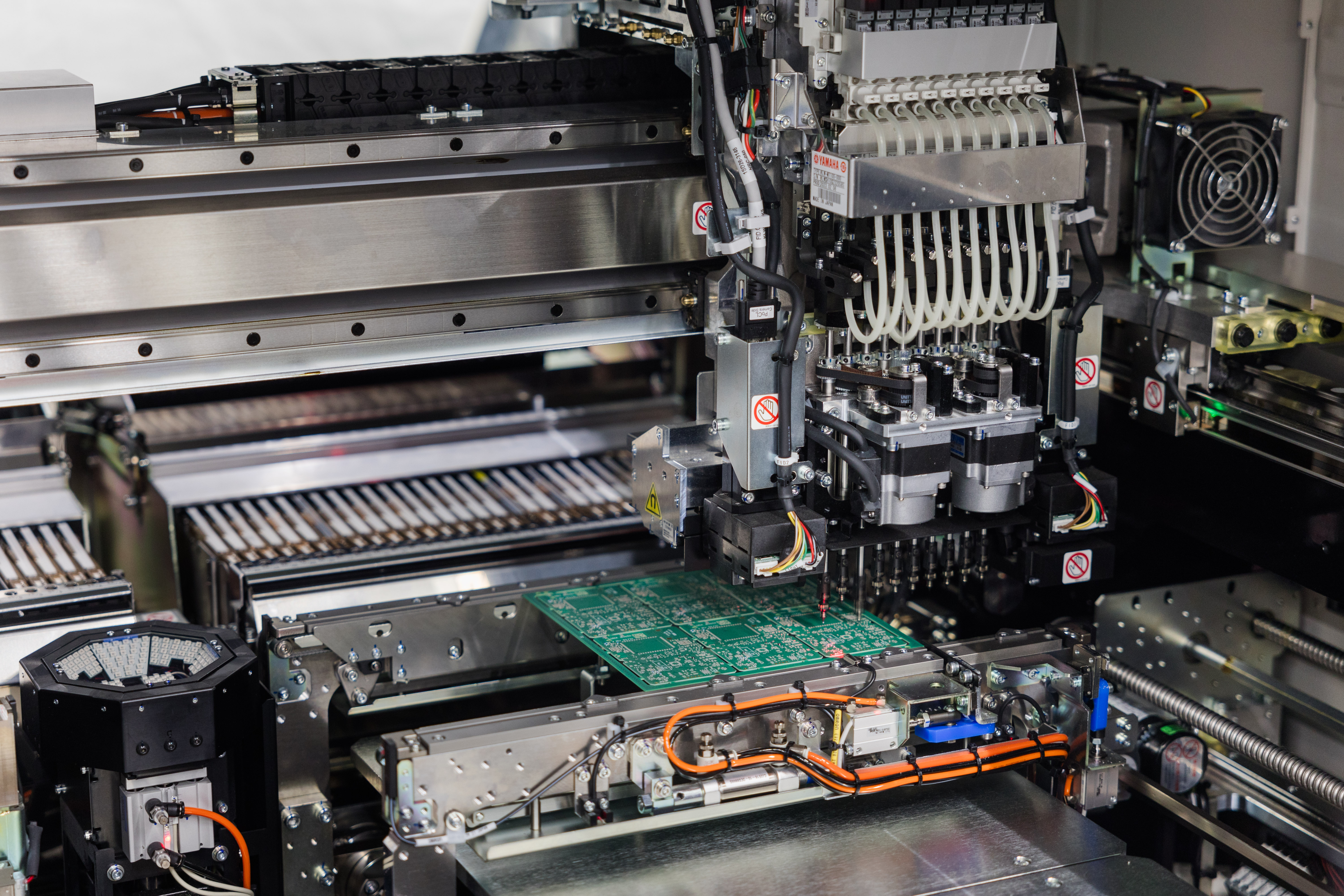
SMT stands for Surface Mount Technology. It is an electronics assembly technology in which components are mounted directly onto the surface of a printed circuit board (PCB).
Unlike Through-Hole Technology (THT), where component leads pass through holes in the PCB, SMT enables the assembly of smaller components at higher densities, with a high degree of automation.
It is one of the most important technologies in modern electronics manufacturing, particularly for products that require miniaturisation, repeatability, precision and manufacturing efficiency.
What You Need to Know
Definition:
SMT is an electronics assembly technology in which Surface Mount Devices (SMDs) are soldered directly onto the surface of a PCB.
Who is it for?
SMT is suitable for companies developing compact, reliable electronic products that require efficient and scalable manufacturing processes.
What problem does it solve?
SMT enables higher component density, automated assembly and improved manufacturing consistency.
HFA's Capabilities:
At HFA, we operate automated SMT production lines designed for high-volume manufacturing, single-sided and double-sided PCB assembly, a wide range of SMD components and high-precision component placement.
Next Steps:
Preparing a PCB for SMT assembly requires validation of the PCB design, Bill of Materials (BOM), pick-and-place files, solder paste Gerber files for stencil manufacturing, the reflow profile to be used for the project, inspection requirements and the testing plan.
How Does the SMT Process Work?
The SMT process begins with the application of solder paste onto the PCB pads. This is carried out using a stencil to ensure controlled and precise deposition. The applied solder paste is then inspected using an in-line Solder Paste Inspection (SPI) system.
Next, SMD components are automatically positioned onto the PCB using high-precision pick-and-place equipment.
The PCB then passes through a reflow oven, where the solder paste melts and forms the electrical and mechanical connections between the components and the board.
Following reflow soldering, inspections are performed to verify assembly quality. Depending on the stage of the process and
the product requirements, inspection technologies may include SPI, Automated Optical Inspection (AOI) and X-ray inspection.
At HFA, our SMT production lines feature automated solder paste printing, high-precision pick-and-place equipment, 3D AOI systems, in-line 3D SPI and offline X-ray inspection for complex components such as Ball Grid Arrays (BGAs) and Land Grid Arrays (LGAs).
Which Components Can Be Assembled Using SMT?
Surface Mount Technology supports the assembly of a wide variety of SMD components, ranging from extremely small passive components to complex integrated circuits.
HFA has the capability to place components in package sizes and formats such as 0100, 2920, BGA, LGA, QFN and QFP, as well as through-hole components using Through-Hole Reflow (THR) and Pin-in-Paste technology, among others.
Our SMT production lines are also configured to accommodate different PCB sizes and levels of assembly complexity.
SMT vs THT: What's the Difference?
The main difference between SMT and THT lies in how electronic components are mounted onto the PCB.
SMT (Surface Mount Technology): Components are mounted directly onto the surface of the PCB.
THT (Through-Hole Technology): Component leads are inserted through holes in the PCB and soldered on the opposite side.
SMT is generally preferred when the manufacturing requirements include:
Higher component density;
Miniaturisation;
Automated production;
Process repeatability;
High-volume manufacturing efficiency.
However, THT remains important for components requiring greater mechanical robustness, connectors, terminals, larger components or specific applications.
Many electronic assemblies combine both technologies.
At HFA, we provide both SMT and THT assembly capabilities, including automated and manual component insertion, wave soldering, selective soldering and manual soldering.
Why Is SMT So Important?
Surface Mount Technology has made it possible to manufacture smaller, more complex and more efficient electronic devices.
It plays a fundamental role in industries such as telecommunications, automotive, healthcare, lighting, aerospace, defence and general electronics.
However, automation does not eliminate the need for technical expertise and rigorous process control.
High-quality SMT assembly depends on several critical factors:
Proper preparation of manufacturing files;
Correct PCB design;
Suitable component footprints;
Stencil compatibility with the assembly process;
Controlled solder paste application;
Appropriate thermal profiles;
Rigorous inspection procedures;
A well-defined testing plan.
For this reason, SMT is much more than a component assembly method. It is a critical manufacturing process that requires precision, process control and technical expertise.
Frequently Asked Questions (FAQ)
Does HFA provide SMT assembly services?
Yes. HFA operates automated SMT assembly lines optimised for high-volume electronics manufacturing.
Can HFA perform SMT assembly on both sides of a PCB?
Yes. HFA provides both single-sided and double-sided SMT assembly.
Does HFA offer AOI and SPI inspection?
Yes. HFA uses 3D Automated Optical Inspection (AOI) systems to inspect electronic assemblies and 3D Solder Paste Inspection (SPI) systems to verify solder paste deposition.
Does HFA provide X-ray inspection?
Yes. HFA offers X-ray inspection to analyse hidden solder joints in complex components such as BGAs and LGAs.

Contact us
Ready to get started?
Contact us today to clarify any questions about our offerings and services.
Where we are
Estrada da Zona Industrial, nº 337
3750-403, Águeda – PORTUGAL
Phone
+351 234 612 680
+351 234 612 689
(Call to the national landline network)
Newsletter
Awards & Certifications

Phone
+351 234 612 680
+351 234 612 689
(Call to the national landline network)
Awards &
Certifications

